
Deep Brain Reorienting (DBR)

Deep Brain Reorienting (DBR)

About Deep Brain Reorienting | Deep Brain Reorienting

The Deep Brain Reorienting / Deep Brain Reorienting (DBR)® method was developed by Dr. Frank Corrigan (Scotland) in 2018. Information from the Deep Brain Reorienting (DBR) website. Translated through the efforts of the team of the INSTITUTE OF NEUROSOMATIC APPROACHES TO TRAUMA AND DISSOCIATION
Deep Brain Reorienting (DBR)® aims to access the core of traumatic experience in a way that tracks the initial physiological sequence in the brainstem – the part of the brain that rapidly becomes activated in situations of danger or attachment rupture.
Threat and attachment can be interconnected when, for example, the experience of abandonment in childhood activates age-related fears for survival.

Orienting Tension

The first structure capable of initiating a motor response is the superior colliculi (SC), which can direct eye movements. The SC also prepare the head to turn, creating tension in the neck muscles. This orienting tension, although often fleeting and imperceptible, is a core component of DBR.

Working with Traumatic Experience

Focusing in a DBR session on the tension in the face and neck that arises as a result of attending to a memory of a traumatic event or to what has become today’s trigger provides an anchor in that part of the memory sequence that occurred before the shock or emotional overload that leads to persistent symptoms. Deepening awareness of this orienting tension provides an anchor for grounding in the present, so that the mind is not overwhelmed by high-intensity emotions and does not become distracted into a compartment containing a state frozen in time, in which connection with the present is lost.

Who DBR Is Suitable For

Although the theory is simple, the practice of DBR can be challenging. The method does not work for everyone. Therapists who find it most useful are those who use transformative trauma therapy approaches based on a body-oriented, or “bottom-up,” approach. These approaches do not rely on restructuring thoughts or meanings at a complex verbal level to control symptoms from the “top down,” nor do they rely on exposure to establish cortical control over fear responses.

Publications

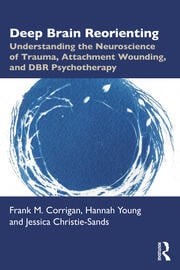
Book “Deep Brain Reorienting” Understanding the Neuroscience of Trauma, Attachment Wounding, and Psychotherapy
“Deep Brain Reorienting” presents a new, scientifically based approach to the treatment of trauma-related disorders. Grounded in neuroscience, this book draws on the latest scientific research on the effects of shock, trauma, and neglect on the brain at the deepest levels. Based on detailed practical material and a strong theoretical foundation, the authors pay particular attention to clinically significant forms of dissociation, as well as attachment wounds and their treatment. This neurobiologically grounded focus offers fresh perspectives, reaching below the level of cognitive, affective, and defensive components of traumatic responding. Written at the intersection of neuroscience and psychotherapy, this book will be invaluable for psychotherapists whose clinical practice requires new ways of working with the consequences of traumatic experience. In addition, several hypotheses will be of interest to research-oriented psychotherapists, as well as clinical researchers in various fields. Deep Brain Reorienting Understanding the Neuroscience of Trauma, Attachment Wounding, and DBR Psychotherapy By Frank M. Corrigan, Hannah Young, Jessica Christie-Sands

Clinical research article

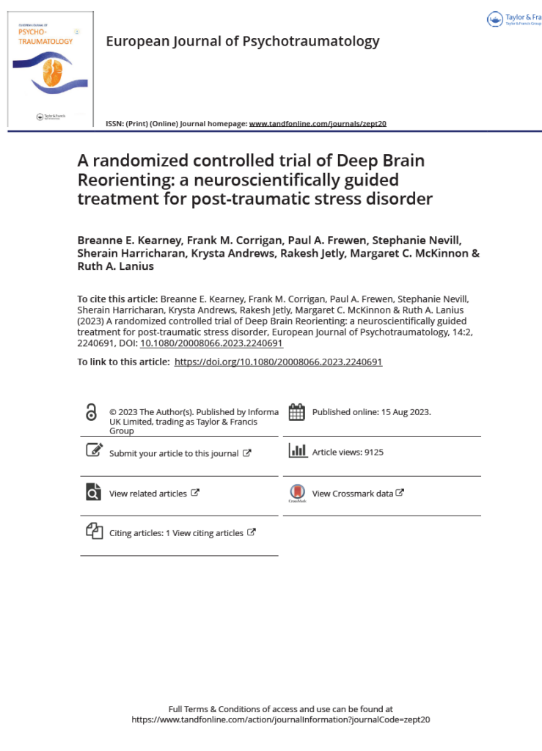
“A randomized controlled trial of Deep Brain Reorienting: a neuroscientifically guided treatment for post-traumatic stress disorder” A randomized controlled trial of Deep Brain Reorienting: a neuroscientifically guided treatment for post-traumatic stress disorder “A randomized controlled trial of Deep Brain Reorienting: a neuroscientifically guided treatment for post-traumatic stress disorder” Breanne E. Kearneya*, Frank M. Corriganb,c*, Paul A. Frewend, Stephanie Nevillc, Sherain Harricharane, Krysta Andrewsf, Rakesh Jetlyg, Margaret C. McKinnon h and Ruth A. Lanius d

Overview

Background: Advanced neuroscience ideas surrounding post-traumatic stress disorder (PTSD) and related symptomatology should give rise to psychotherapeutic treatment methods that integrate this knowledge into practice. Deep Brain Reorienting (DBR) is a neuroscientifically guided psychotherapeutic intervention that targets the neurophysiological sequence at the level of the brainstem that arose during a traumatic event. Given that current treatment methods have a non-response rate of up to 50% and a high dropout rate (>18%), the DBR method was investigated as a possible candidate for effective treatment of some individuals with PTSD. Aim: To conduct an interim assessment of the effectiveness of an eight-session DBR clinical trial delivered by videoconference compared with a waitlist control (WL) of individuals with PTSD. Method: Fifty-four individuals with PTSD were randomly assigned to two groups: DBR (N = 29) or WL (N = 25). At baseline, after therapy, and at three-month follow-up, the severity of PTSD symptoms in participants was assessed using the Clinician Administered PTSD Scale (CAPS-5). This interim analysis of the clinical trial is registered with the U. S. National Institute of Health (NCT04317820). Results: Significant differences between groups in overall CAPS scores and in all subscale scores (re-experiencing, avoidance, negative changes in cognition/mood, changes in arousal/reactivity) were found at the post-treatment stage (CAPS-total: Cohen’s d = 1.17) and at the 3-month follow-up (3MFU/3M) (CAPS-total: Cohen’s d = 1.18). A significant reduction in overall CAPS scores and all subscale scores was observed within the DBR group before and after therapy (36.6% reduction in overall CAPS), while no significant reduction occurred in the WL group. After DBR, 48.3% at the post-treatment stage and 52.0% at the 3M stage no longer met the criteria for PTSD. Dropout was minimal – one participant did not complete the therapy; eight participants were lost at the 3M stage. Conclusions: These results provide new evidence of the effectiveness of DBR as a well-tolerated therapy based on theoretical advances that highlight changes in subcortical mechanisms in PTSD and related symptomatology. Further research using larger sample sizes, neuroimaging data, as well as comparison or integration with other psychotherapeutic approaches is warranted. Trial registration: ClinicalTrials.gov identifier: NCT04317820. © Translation from English was carried out for educational purposes as part of the DBR — Deep Brain Reorienting training course by the Center for Educational Projects “Tree of Knowledge” of Karine Kocharyan in 2024 — now the Institute of Neurosomatic Approaches to Trauma and Dissociation. Odesa, Ukraine. According to the requirements of the copyright holders, the translation of the article may not be published in the public domain. The text of the article is provided by participants of the training upon request.
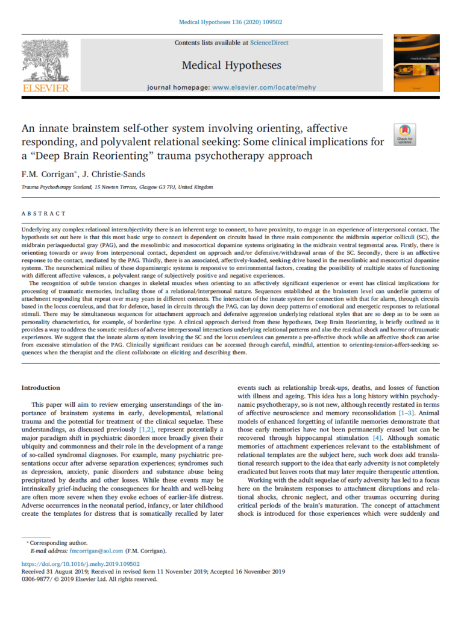
An innate brainstem self-other system involving orienting, affective responding, and polyvalent relational seeking: Some clinical implications for a “Deep Brain Reorienting” trauma psychotherapy approach F.M. Corrigan⁎, J. Christie-Sands Trauma Psychotherapy Scotland, 15 Newton Terrace, Glasgow G3 7PJ, United Kingdom   An innate brainstem “self-other” system involving orienting, affective responding, and polyvalent relational seeking: Some clinical implications for a “Deep Brain Reorienting” trauma psychotherapy approach F.M. Corrigan*, J. Christie-Sands
Trauma Psychotherapy Scotland, 15 Newton Terrace, Glasgow G3 7PJ, United Kingdom The hypotheses underlying DBR were outlined in an article co-authored with Jessica Christie-Sands in the journal Medical Hypotheses (2020, 136, 109502).

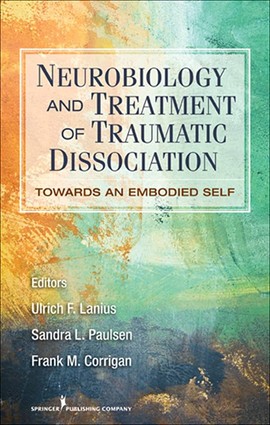
Neurobiology and Treatment of Traumatic Dissociation: Towards an Embodied Self Lanius, UF, Paulsen, SL, & Corrigan FM, Springer, New York, 2014

Neurobiology and Treatment of Traumatic Dissociation: Towards an Embodied “Self” This book, which brings together the contributions of expert clinicians and researchers in the field of traumatic stress and dissociation, for the first time combines contemporary neuroscience research on traumatic dissociation with several advanced treatment approaches, providing a comprehensive, neurobiologically grounded approach to treatment. The text discusses contemporary neuroscience research on traumatic stress and dissociation, including attachment theory, affective neuroscience, polyvagal theory, structural dissociation, and information processing theory, making it possible to create a comprehensive model that guides treatment and clinical interventions for traumatic dissociation. This model is then integrated with phased treatment and contemporary therapeutic interventions, including EMDR, somatic and body psychotherapy approaches, Ego State Therapy, and adjunctive pharmacological interventions. Readers will receive practical recommendations for clinical decision-making, enabling them to make informed choices about interventions that will contribute to optimal treatment outcomes. Lanius, U.F., Paulsen, S.L., & Corrigan F.M., Springer, New York, 2014.

Evidence-Based Trauma Psychotherapy: Limitations of Approaches and Prospects for the Application of Deep Brain Reorienting

The First Ukrainian Article on the Deep Brain Reorienting (DBR) Method

The author is Tetiana Aslanian.

First of all, I would like to congratulate Tetiana on the publication of the article and thank her for the incredible work she has done to write it.

Tetiana Aslanian holds a PhD in Psychology and is a Senior Researcher at the Department of Psychology of Small Groups and Intergroup Relations at the Institute of Social and Political Psychology of the National Academy of Educational Sciences of Ukraine. In addition, she is a therapist who has completed three levels of the Basic Training and the first level of Advanced Training in Early Trauma in the DBR method.

Tetiana addresses the following important questions:

How does DBR differ from other methods? Tetiana analyses the advantages of working with trauma and the differences between methods such as Prolonged Exposure (PE), Cognitive Processing Therapy (CPT), and a number of other forms of trauma-focused cognitive behavioural therapy.

As well as EMDR, which occupies a separate place.

In addition, Tetiana also examines body-oriented approaches such as Somatic Experiencing (SE) and Sensorimotor Psychotherapy (SP; at the Institute of Neurosomatic Approaches to Trauma and Dissociation Therapy, this is a training programme).

And, of course, Tetiana analyses the possibilities of DBR — a method that addresses the precortical level, a level that other modalities are unable to reach. At this level, the response to threat is only beginning to form — before the full development of affect, cognitive appraisal, or dissociative defence.

DBR focuses on the early orienting components of the threat response and offers a different logic of access to traumatic experience than classical exposure models.


— quoting Tetiana Aslanian

Comparison of Evidence-Based Psychotherapeutic Methods for Working with Trauma

A very interesting comparative table is included in the article: “Comparison of Evidence-Based Psychotherapeutic Methods for Working with Trauma.”

Tetiana provides a brief but very clear description of the logic of the method and its main components and structures that are involved in the work, as well as examining the logic of the therapeutic process.

You will find an overview of the empirical evidence supporting the effectiveness of Deep Brain Reorienting: a randomised controlled trial.

And most importantly: how DBR can be helpful in times of war, during prolonged trauma and prolonged life-threatening danger.

The article is written in clear language, with well-structured arguments — Tetiana has done an incredible piece of work.

Download the article

One of the most unique aspects of DBR as a trauma-focused therapy is the embodiment of a natural healing process, resonant with the evolutionary process of the development of the brain and nervous system.
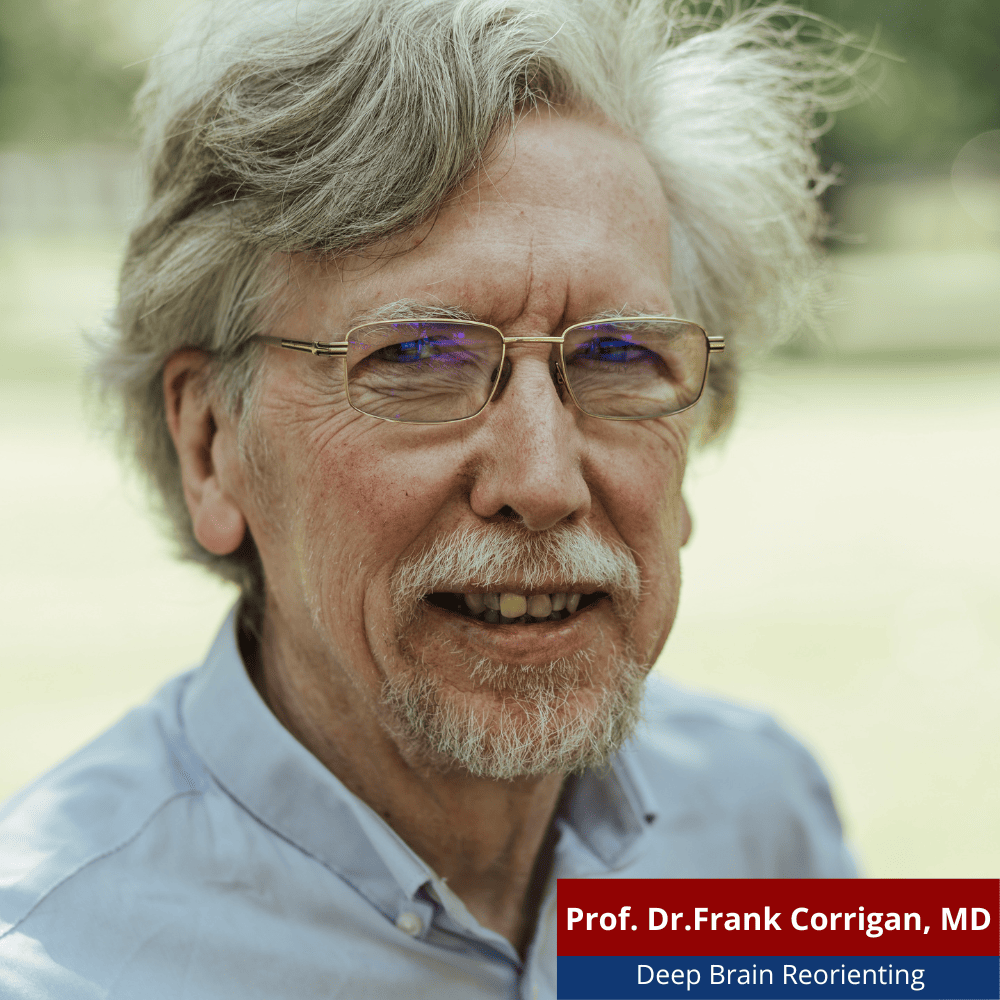
Dr. Frank Corrigan, author of the DBR method

DBR in Ukraine

The history of the Method in Ukraine began on March 17, 2022, one month after the beginning of the full-scale invasion. It was supposed to begin with the introductory webinar “Trauma and Dissociation: The Role of the Midbrain in Symptomatology and Therapy,” which we had arranged with Frank Corrigan. We cancelled the webinar, but instead, Dr. Corrigan gifted Ukrainian professionals a one-day training — the aim of which was to teach the basic DBR technique so that colleagues could help each other and their clients overcome the consequences of shock.

The First Clinical Group

After this training, a small group of enthusiasts was formed who began studying the method in greater detail with the help of Dr. Corrigan and Jessica Christie-Sands. This was the very first Clinical Group, which met once a month on Thursdays from 13:00 to 15:00 (they still work this way — everything is stable with us) for two years. During this time, a core group of strong professionals was formed who could already help newcomers during the training as facilitators.

Training in the DBR Method

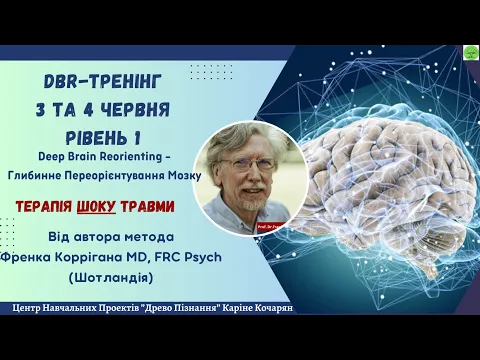
June 3, 2024 The first DBR training cohort started.
August 2026 We are opening a new — already the third — cohort.

The First Ukrainian DBR Conference

October 30–31 The First Ukrainian DBR Conference will take place online. Learn more about the conference

DBR Professionals Register

Register of professionals who have completed / are currently undergoing training in the DBR method.

ПОПЕРЕДНЯ РЕЄСТРАЦІЯ НА 4 ПОТІК​

Trainers in the Field

Frank Corrigan

Frank Corrigan

Jessica Christie-Sands

Jessica Christie-Sands

Hannah Young

Hannah Young

Each training day includes a theoretical part, demo sessions with volunteers from among the participants based on the theoretical material, conducted by Dr. Frank Corrigan. Discussion of the theory. The DE-SELF exercise in small groups. Practicing skills in groups of three, during which participants are assisted by facilitator-colleagues who already have experience working with the DBR method, all with the support and supervision of the trainers. Discussion of the practical work.

All participants are provided with presentations translated into Ukrainian, practical work manuals, the sequence for conducting a DBR session, and other necessary supporting videos and printed materials. And our caring support throughout the entire training 😉

Is there a certification procedure in this method?

Yes, a certification procedure already exists, and it is conducted exclusively by DBR Trainings. This is the ONLY organization in the world approved by Professor Frank Corrigan that issues certificates.

Three levels of certification:

DBR-P (Practitioner)
DBR-C (Consultant)
DBR-T (Trainer).

At present, information about the full certification procedure within the Ukrainian community is still being developed (the hyperlink is retained).

For now, you can ознакомиться with the requirements on the DBR Trainings website.

In addition to the main training, participants have the opportunity to take part in clinical groups, which take place once a month. Attendance is not mandatory for the main training, but they are very useful for supporting practice and are recommended for those who plan to become certified in the method.

How do Clinical Groups work?

Once a month, on Thursday, from 13:00 to 15:00 — this is an established and traditional time that has been in place since the very beginning of our collaboration with Dr. Corrigan, namely since April 2022.

Part of the meeting is devoted to answering participants’ questions or short theoretical lectures by Dr. Corrigan, and part is devoted to a DEMO consultation conducted by Dr. Frank Corrigan with a volunteer and its discussion.

We form the queue in advance according to the meeting schedule.

The structure may change depending on the needs of the group; for example, the DEMO may be replaced by a clinical case discussion or a theoretical presentation.

The sessions are recorded, and the recording is provided to all participants.

The cost of participation in the clinical group is 40 euros in hryvnia at the exchange rate on the day of payment.

The clinical group operates according to the group-setting principle, where participants pay for missed sessions.

Yes, on November 28, 2024, the DBR-Ukraine community was created. The community is unofficial — no NGO or SRO has been established and will not be established.

We meet once a quarter, on the last Thursday of the month.

The first meeting took place on November 28.

Yes, we always record the theoretical part and DEMO sessions.

In order to receive a certificate for completing Level 1, 2, or 3 of the training, your 100% attendance during the training is mandatory!

The training cannot be completed through recordings.

This training is for qualified mental health professionals who have experience in psychotherapeutic work in general and/or with psychological trauma in particular.

  • primary professional qualification in the field of mental health and/or psychotherapy
  • a minimum of 2 years of clinical psychotherapy experience
  • experience working with trauma and/or training in psychologically informed trauma-focused approaches

Please note the additional requirements for training at Level 3 of the DBR training.

IN UAH TO A SOLE PROPRIETOR’S ACCOUNT

or via the WayForPay service

The payment details will be indicated in the registration form or can be obtained from the TG manager, ALYONA.

Payment for this training is accepted only after completing a short introductory interview.

Interview with Frank Corrigan

With Jessica Christie-Sands

Feedback from our participants

About Deep Brain Reorienting | Deep Brain Reorienting

The Deep Brain Reorienting / Deep Brain Reorienting (DBR)® method was developed by Dr. Frank Corrigan (Scotland) in 2018. Information from the Deep Brain Reorienting (DBR) website. Translated through the efforts of the team of the INSTITUTE OF NEUROSOMATIC APPROACHES TO TRAUMA AND DISSOCIATION
Deep Brain Reorienting (DBR)® aims to access the core of traumatic experience in a way that tracks the initial physiological sequence in the brainstem – the part of the brain that rapidly becomes activated in situations of danger or attachment rupture.
Threat and attachment can be interconnected when, for example, the experience of abandonment in childhood activates age-related fears for survival.

Orienting Tension

The first structure capable of initiating a motor response is the superior colliculi (SC), which can direct eye movements. The SC also prepare the head to turn, creating tension in the neck muscles. This orienting tension, although often fleeting and imperceptible, is a core component of DBR.

Working with Traumatic Experience

Focusing in a DBR session on the tension in the face and neck that arises as a result of attending to a memory of a traumatic event or to what has become today’s trigger provides an anchor in that part of the memory sequence that occurred before the shock or emotional overload that leads to persistent symptoms. Deepening awareness of this orienting tension provides an anchor for grounding in the present, so that the mind is not overwhelmed by high-intensity emotions and does not become distracted into a compartment containing a state frozen in time, in which connection with the present is lost.

Who DBR Is Suitable For

Although the theory is simple, the practice of DBR can be challenging. The method does not work for everyone. Therapists who find it most useful are those who use transformative trauma therapy approaches based on a body-oriented, or “bottom-up,” approach. These approaches do not rely on restructuring thoughts or meanings at a complex verbal level to control symptoms from the “top down,” nor do they rely on exposure to establish cortical control over fear responses.

Direction coaches

Copyright © 2026 ІНСТИТУТ НЕЙРОСОМАТИЧНИХ ПІДХОДІВ ТЕРАПІЇ ТРАВМИ ТА ДИСОЦІАЦІЇ Inspiro Theme by WPZOOM
Scroll to top
View programs Contact us
Переглянути програми Зв'язатися з нами